

U.S. Crypto Policy | October 27, 2026 | CoinXplore
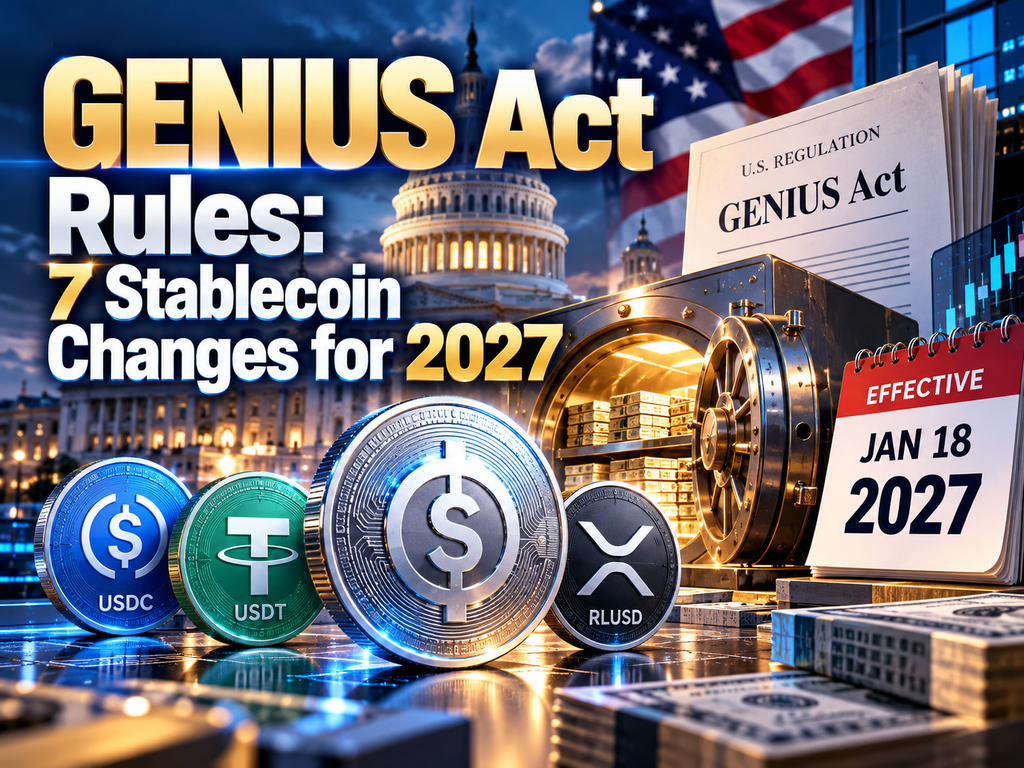
GENIUS Act Rules: 7 Stablecoin Changes for 2027
A new deadline is approaching for America’s digital dollars. On October 21, U.S. bank regulators finalized detailed rules that will reshape how certain payment stablecoins are issued, backed, and redeemed.
The GENIUS Act rules take effect on January 18, 2027. That matters for investors who use USDC, USDT, or Ripple’s RLUSD to trade, transfer money, or hold digital dollars.
But the headline is easy to misread. The law was signed in 2025. What just became final is the Office of the Comptroller of the Currency’s (OCC) implementation rule—not every remaining U.S. crypto regulation.
Here are seven concrete changes, including a key twist involving stablecoin rewards.
The new U.S. stablecoin framework is not simply about making crypto legal. It sets enforceable standards for issuers—and leaves important questions about exchange rewards and foreign-issued coins to be judged carefully.
GENIUS Act Rules: What Did the OCC Finalize?
The GENIUS Act—short for the Guiding and Establishing National Innovation for U.S. Stablecoins Act—became federal law on July 18, 2025.
The OCC published its final implementing rule on October 21, 2026. The text appeared in the Federal Register on October 23. The requirements covered by this rule become effective on January 18, 2027.
Three dates that should not be confused
| Date | What happened | Why it matters |
|---|---|---|
| July 18, 2025 | GENIUS Act signed into law | The statutory framework was enacted. |
| October 21, 2026 | OCC final rule announced | Detailed standards were finalized for entities within OCC jurisdiction. |
| January 18, 2027 | Act and OCC rule take effect | Applicable compliance obligations begin, subject to lawful exceptions and waivers. |
The rule covers matters such as reserve assets, redemption, issuer licensing, custody, supervision, and risk management. It is not an announcement that every stablecoin currently on an exchange has already received federal approval.
1. Stablecoin Reserves Must Cover Tokens 1:1
Under the new framework, an OCC-regulated permitted issuer must maintain qualifying reserves with a value at least equal to its outstanding payment stablecoins.
Think of a hypothetical issuer with $1 billion in outstanding dollar-denominated coins. It must maintain at least $1 billion in qualifying reserve value. Issuing more tokens creates a matching reserve obligation.
Eligible reserves can include U.S. dollars and qualifying liquid U.S. government-related assets, subject to the rule’s conditions. Reserve portfolios also face liquidity, concentration, and risk-management standards.
Does 1:1 backing mean zero risk?
No. The market value of assets can change. A bank, custodian, payment processor, or issuer can encounter operational problems. Redemptions can also be affected by legal and identity-verification requirements.
The GENIUS Act rules require reserve values to be assessed properly. But 1:1 backing is a regulatory obligation, not a promise that no stablecoin can ever trade below $1.
Investors should look at the actual reserve composition, not just an issuer’s promise that every token is backed. Cash and short-term liquid assets generally pose different risks from less-liquid investments.
2. Stablecoin Redemptions Get a Two-Business-Day Standard
For covered issuers, the final rule establishes a baseline limit of two business days for timely redemption.
That is the issuer’s obligation to redeem qualifying requests. It is not a blanket promise that any exchange customer can sell any stablecoin and receive dollars in a bank account within 48 hours.
Under the GENIUS Act rules, the clock depends on the issuer receiving the order and the customer satisfying applicable requirements, including onboarding. The OCC also clarified when the issuer’s outgoing transfer counts as processed.
3. A 10% redemption surge triggers a regulatory alert
If redemption requests exceed 10% of a stablecoin brand’s outstanding issuance value within 24 hours, the issuer must notify the OCC within 24 hours.
For a hypothetical $10 billion stablecoin, that means requests totaling more than $1 billion over a single 24-hour period would cross the threshold.
The final rule does not automatically impose a seven-day redemption delay at that point. That automatic extension was part of an earlier proposal and was removed. The issuer may request relief, but the OCC decides whether an extension or limitation is justified.
This difference matters during market stress, when investors want clarity about whether redemptions can be delayed.
4. The Stablecoin Yield Ban Has an Important Exception to Watch
One of the most closely watched GENIUS Act rules concerns interest and rewards.
The law prohibits a covered issuer from paying holders interest or yield solely for holding, using, or retaining a payment stablecoin. That prohibition remains in the OCC’s final rule.
However, the OCC removed a proposed rebuttable presumption that would have treated certain arrangements involving affiliated or related third parties as potentially prohibited from the outset.
Does this mean exchange rewards are automatically legal?
No. The OCC did not give every exchange, affiliate, or third-party reward program a blanket exemption.
Instead, the agency said it will evaluate arrangements based on their actual facts. It also retains authority to prevent issuers from evading the prohibition through third parties.
That leaves an important distinction: issuer-paid yield is prohibited under the rule’s terms, while independently structured third-party rewards require their own legal analysis.
For U.S. customers, the practical question is who funds a reward and what activity generates it. A promotional percentage is not the same as an FDIC-insured savings rate.
The biggest market debate may not be whether stablecoins are backed 1:1. It may be how banks, crypto platforms, and issuers compete for customers when rewards are structured differently.

CoinXplore may earn a commission from qualifying purchases through this advertisement at no additional cost to you.
5. Stablecoin Issuers Face a Clearer U.S. Licensing Path
Under the GENIUS Act, issuing a payment stablecoin in the United States generally requires qualifying as a permitted issuer once the framework takes effect.
Depending on the institution, supervision can involve federal authorities or an eligible state framework. The OCC’s rule addresses certain bank subsidiaries, approved nonbank federal issuers, and qualifying state issuers that come under its authority.
What about companies already operating?
On October 21, the OCC issued separate guidance for applications and waiver requests. Some applicants with a qualifying pending application as of January 18, 2027, may request a temporary waiver.
The regulator can grant such relief for up to 12 months under the statute. It is not automatic approval or a universal grace period.
As of October 27, the OCC said it was not yet accepting applications or waivers. It plans to announce the opening once the required federal paperwork process is approved.
6. Foreign-Issued Stablecoins Face Their Own U.S. Conditions
This is particularly relevant to Tether’s USDT. The GENIUS Act creates conditions for foreign-issued payment stablecoins made available to customers in the United States.
Those conditions include matters such as eligible issuer status, lawful-order compliance, and applicable registration or recognition requirements. Foreign issuer treatment does not become identical to that of every domestic issuer.
Will USDT automatically disappear from U.S. exchanges?
The October 21 OCC announcement does not establish that USDT was immediately banned or that a specific exchange must remove it today.
Future U.S. availability depends on the applicable rules, the issuer’s compliance path, and a platform’s legal obligations. It is too early to declare a particular token fully approved or categorically prohibited under the entire future framework.
Tether has already pursued a separate domestic approach. In January 2026 it announced USA₮, a U.S.-focused dollar stablecoin issued by Anchorage Digital Bank, N.A.
That makes USDT and USA₮ distinct products. Readers should not treat the existence of USA₮ as proof that every USDT compliance question has been resolved.
7. Stablecoin Disclosures Become Part of the Protection Test
The OCC’s rules also address redemption disclosures, reporting, audits, risk controls, supervision, and custody responsibilities.
Covered issuers must provide meaningful information about redemption rights and limitations. The rule also requires clear statements explaining that payment stablecoins are not ordinary bank deposits.
A stablecoin is not an FDIC-insured savings account
A dollar-pegged token is not automatically insured because its reserves include U.S. Treasury securities or deposits at regulated banks.
The final rule calls for disclosures that payment stablecoins are not deposits, not backed by the full faith and credit of the United States, and not covered by FDIC or NCUA deposit or share insurance.
This is a major consumer distinction. A stable price target, federal supervision, and federal deposit insurance are three different concepts.
It does not say all stablecoins are insured. It does not make all exchange reward programs legal. And it does not mean every token currently trading in the U.S. has passed the same federal approval process.
What the GENIUS Act Rules Mean for USDC, USDT, and RLUSD
The GENIUS Act rules create a common policy framework, but these stablecoins do not have identical issuers, licenses, or business models.
| Asset | Confirmed context | What investors should check |
|---|---|---|
| USDC | Issued by Circle affiliates. Circle received final OCC approval in July 2026 for a national trust bank supporting institutional custody. | Which entity issues the token, its reserve reports, and its GENIUS Act authorization status. |
| USDT | Tether’s established international dollar stablecoin. | Foreign-issuer eligibility and platform-specific U.S. availability under applicable timelines. |
| USA₮ | Tether’s separate U.S.-focused stablecoin, announced as launched in January 2026, with Anchorage Digital Bank as issuer. | Issuer documentation, circulation, access conditions, and applicable authorizations. |
| RLUSD | Issued by Ripple’s NYDFS-supervised Standard Custody & Trust Company. | Reserve attestations, issuer obligations, and the relationship between state and federal frameworks. |
Two distinctions are worth emphasizing.
First, a national trust bank charter is not automatically the same as a GENIUS Act payment-stablecoin issuer approval. The relevant issuing entity and authorization must be identified.
Second, regulation is not a token price guarantee. A strong institutional story may improve confidence in a company or network without directly increasing demand for an unrelated crypto asset.
Could the Rules Affect Bitcoin, Ethereum, or XRP?
Stablecoins are important trading and payment tools across the crypto market. Clearer rules could encourage some financial institutions to evaluate digital-dollar infrastructure more seriously.
Bitcoin and Ethereum
If compliant stablecoin usage expands, exchanges and financial applications could gain more liquid dollar-based settlement tools. That may support broader crypto market infrastructure.
But it would be a mistake to conclude that the new rule automatically sends Bitcoin or Ethereum higher. Interest rates, investor risk appetite, and actual demand still matter.
XRP and the Ripple ecosystem
Ripple’s RLUSD may benefit from the industry’s focus on regulated dollar settlement products. Yet RLUSD growth does not automatically translate into equivalent XRP purchases.
Evidence would need to come from genuine transaction activity, liquidity usage, and the specific role XRP plays in the relevant payment flows.
For CoinXplore, the most useful signal is not whether a company uses the phrase “regulatory clarity.” It is whether customers actually change how they move or hold money.
What Is Still Unfinished Before January 2027?
The October 21 announcement finalized major OCC requirements. It did not complete every rulemaking connected to the GENIUS Act.
The OCC said Bank Secrecy Act, anti-money-laundering, and sanctions-related regulations will be addressed separately in coordination with the Treasury Department.
The agency also published related application guidance and revised reporting forms. As of October 27, the application intake process had not yet opened.
A practical checklist for U.S. stablecoin users
- Identify the actual issuer. A token’s brand and its legal issuer may be different entities.
- Read the reserve reports. Look beyond the phrase “fully backed.”
- Check redemption eligibility. Direct issuer redemption may require onboarding and may differ from exchange trading.
- Understand rewards. Ask who funds them and what contractual conditions apply.
- Check protections. Do not confuse a stablecoin with an insured bank deposit.
- Watch the calendar. January 18, 2027, is the major effective date, not October 21, 2026.
GENIUS Act Rules: Frequently Asked Questions
Are the new U.S. stablecoin rules already in effect?
The OCC announced its final rule on October 21, 2026, but the rule and the GENIUS Act take effect on January 18, 2027.
Are stablecoins now FDIC insured?
No. The OCC requires clear disclosures that payment stablecoins are not deposits and are not covered by federal deposit or share insurance.
Can Coinbase or another exchange still offer stablecoin rewards?
The final OCC rule does not automatically prohibit every third-party reward arrangement. It also does not universally approve them. Legality depends on how each arrangement works and whether an issuer is evading the yield restriction.
Will USDT be banned in the United States?
The October 21 final rule does not announce an immediate blanket ban on USDT. Foreign-issuer compliance and U.S. platform availability require a separate, fact-specific review.
Does the GENIUS Act make XRP a regulated stablecoin?
No. XRP and Ripple’s dollar-backed RLUSD are different digital assets. The payment stablecoin rules do not turn XRP into a dollar-pegged token.
CoinXplore may earn a commission from qualifying purchases through this advertisement at no additional cost to you.
COINXPLORE View: Regulation Is Becoming an Operating Test
My reading of the GENIUS Act rules is that U.S. stablecoin competition is entering a more operational phase.
One-to-one reserves are essential, but investors should pay just as much attention to redemption reliability, issuer governance, and transparent disclosures. The OCC’s decision to remove a proposed presumption around third-party rewards also leaves a meaningful competitive question unresolved.
USDC, USDT, USA₮, and RLUSD will not all follow the same path. Their issuers and oversight arrangements differ, and it would be premature to announce a regulatory winner.
The most important developments to watch under the GENIUS Act rules are actual licenses, eligible waivers, published reserve data, redemption performance, and how platforms adapt before January 18, 2027.
The GENIUS Act rules set clearer standards for digital dollars, but the real winners will be determined by compliance, liquidity, and customer trust—not headlines alone.
- OCC — October 21, 2026, final-rule announcement
- OCC Bulletin 2026-50 — GENIUS Act Regulations
- Federal Register — final rule (91 FR 67000)
- OCC Bulletin 2026-51 — applications and waivers
- OCC — GENIUS Act application status
- Circle — national trust bank approval (July 2026)
- Tether — USA₮ launch announcement (January 2026)
- Ripple — RLUSD issuer and reserve transparency
Reporting cutoff: October 27, 2026. Facts and regulatory status may change after publication. The scenarios and market implications discussed above are CoinXplore analysis, not regulatory determinations.
This article provides independent commentary for general information only. It is not financial, legal, tax, or investment advice. Cryptocurrency and stablecoin products carry market, issuer, operational, and regulatory risks, including possible loss of capital. Confirm current rules and eligibility with the relevant authorities and providers before acting.